Tuesday, 6 June 2017

The Modern Development of AntiFriction Bearings

Precision

Since the assembly of ball and roller bearings involves very careful processing of the finest material, and delivery to the user in a finely adjusted condition , ball and roller bearings are used where precision of rotating elements must be of the highest order.  The external dimensions of bearings are standardized as to nominal diameters and working tolerances, and in ball bearing and roller bearing plants of the present day the finest equipment is used, not only for processing but for the inspection of component parts, in order to insure the precision demanded by the principle of the bearing and the service into which it is to be placed.


Accurate and true-running bearings are for the first time possible with the ball and roller types, vibration, chatter,m and other undesirable conditions which may arise in plain bearings being largely eliminated by the proper selection and applications of anti-friction bearings to many types of machinery.  Gears can be kept in exact alignment and adjustment.  Grinding wheels can best supported as to produce the finest work, woodworking tools can be made to produce a more accurate finish, and at higher rates of speeds than would be possible with plain bearings.  Parts which must be maintained with small but definite clearances are most successfully carried on ball bearings, and these qualities are only available during the initial period of operation but extend through their long and useful life.

Elsewhere are described the various degrees of precision  which are available to the user of ball bearings.  The so-called S.A.E. tolerances themselves are precision tolerances, but for even finer requirements still further degrees of accuracy are obtainable.

Lubrication

The load-carrying element in the plain or journal bearing is a firm of lubricant forced between the rotating and stationary surfaces by the action of the journal itself, and by the tendency of the lubricant to adhere to the stationary surface on the other side.  This action drives a wedge of lubricant between the surfaces and separates them from actual metal – to – metal contact.  The plain bearing is forced to rely upon this action for its effectiveness , while in the ball and roller bearing this condition does not apply, as rolling elements are interposed between the raceways.  Lubricant, therefore, takes what may be termed a secondary (although important) place in the functioning of an anti-friction bearing.  It lubricate the retainers, where they are in slight sliding contact with the balls, as well as the twilight zone where rolling friction verges on sliding friction, and it serves as a protector for the finely finished surfaces of the balls and raceways.


These considerations are responsible for the starting friction of ball and roller bearings being very low, and of plain bearings high.  They press lubricating problems on teh designer and user of the plain journal to a far greater extent than with anti-friction bearings, where the rolling elements are kept in their proper relation with respect to the races by the retainer or separator, and maintain their location during service — in operation and out.

The design of housing for lubrication and the selection procedure in applying lubricant to the various ball bearing designs are treated separately in this catalog.  In summing up, it is well to remember that anti-friction bearings will require comparatively little lubricant and offer a fairly wide choice of grease or oils.  Maintenance is low and periods between lubrication can be unusually long.

Tuesday, 16 May 2017

Most reasons to use composite plastic bearings

Composite plastic bearings combine thermoplastics, fibrous reinforcements, and solid lubricants for tailored bearing solutions with predictable lifetime in a wide variety of applications. These bushings run without maintenance, external lubrication, resist corrosion and debris, fit precisely with little creep, conduct heat efficiently, and dampen vibrations while maintaining high compressive strength. Read on for the top ten reasons to consider plastic bearings.

1. Lighter weight than metallic bearings

Swapping metallic plastic bushings to composite plastic bushings can reduce weight by 25% or more. The difference in density between composite plastic materials and metals - 1 to 3 g/cm3 vs. 7 to 9 g/cm3 - the weight reduction available with plastic bearings is obvious.

2. Corrosion resistance

Metal-free plastic bearings do not rust, and most available materials will not corrode in acidic or basic solutions, or when exposed to traditional lubricants. The product line also includes bearings that are able to resist harsh acids, such as hydrochloric acid, as well as UV and other high-energy radiation. Chemical resistance can change with temperature and chemical concentration, so be sure to take your specific application conditions into account.

3. 100% self-lubricating

plastic bearings are designed to run dry, without any external lubrication. Fiber reinforcements create millions of tiny chambers, which house particles of solid lubricant which are released as friction against a shaft occurs. Homogeneous blending of the plastic material means that lubricant cannot be pressed out, and will last throughout the entire service life of the bearing.


4. Forgiving of shock and edge loads; vibration dampening

Plastic bearings run quietly and absorb or dampen vibrations. Their mechanical loss factor, and indicator of vibration-dampening capability, is up to 250 times that of metallic bearings. The fiber-reinforced material blends are tailored to specific application requirements, helping bearings stand up to shock and edge loads in a wide range of application settings

5. Pairs well with a range of shaft materials

Plastic bearings can pair with any shaft material without corrosion issues, but not all shaft-bearing pairs are equal. Extensive testing and experience have provided with a massive database of bearing wear results when paired with different shaft hardness, roughness, and materials makeup. (Excellent wear performance depends on pairing the right bushing material with the shaft.

6. Excellent wear rates

When a shaft with a composite plastic bushing starts to move, bits of solid lubricant and thermoplastic abrade to fill shaft imperfections and provide continuous lubrication, minimizing stick-slip and wear. Abrasion rates drop dramatically after initial startup, becoming negligible during continuous operation. The plastic bearing offers optimal wear thickness throughout the entire wall thickness of the bearing.

7. No maintenance required

Based on results of thousands of empirical tests specialists can recommend plastic bearings that are ready to “fit and forget.” Test data allows engineers choose the best bearing/shaft combination and predict maintenance-free service life based on application factors. When combining this with the lack of required external lubrication, you get a completely maintenance-free bearing solution.

8. Dirt and dust resistance

Metallic bearings wear prematurely if abrasive dirt particles get into them, but plastic bearings are able to ‘absorb’ these particles, incorporating them into the plastic material itself. Additionally, the lack of required grease and oil does not attract debris.

9. Special application materials available

If your application requires specific material requirements, such as FDA or EU-directive compliance, the material range offers a number of applicable products and materials. 

Wednesday, 12 April 2017

New ideas about Special housing keeps bearings cool


Oil in the reservoir is below the bearing, eliminating heat from the bearing churning through the oil. For more cooling, optional single or dual tubes, each operating independently, send water into and out of the housing. Tests show that one tube using 59F water reduces bearing and oil temperature by 12 and 32F, respectively. Two cooling tubes reduces them by 16 and 38F.


The design uses fewer parts than the company’s last bearing housing. For example, the previous housing needed up to 20 bolts on end covers. The new design has no end covers. Fewer parts reduces the risk of oil leakage. Labyrinth seals prevent contaminants from entering the bearing and are built to retain oil, feeding it back into the cast-iron housing

Monday, 27 March 2017

Automotive Bearings Market Growth with Worldwide Industry

Bearings are used to enable rotational or linear movement, and to disable the unwanted friction and handling stress. Bearings are integrated in automotive to constrain the relative motion and allow desired motion, due to which, a vehicle can enhance its speed and efficiency. Vehicles have many rotating parts, and bearing are used in almost all parts. For example, axle bearings are used to enable wheel axles to turn.

The structure of bearing is simple, it has a ball, which has internal & external smooth metal surfaces, which helps bearings to move. The ball in the bearing is responsible for carrying the weight of the load, and load’s weight is responsible for giving a push to the bearing’s rotation.


There are different types of bearings used in the automotive, such as ball, roller & thrust bearings, housed units, needle roller bearings, plain bearings, plummer blocks, sleeves, slim section bearings, spherical roller bearings, etc. For instance, applications such as wheels and transmissions use roller bearings, as roller bearings support heavy-duty applications.


The demand for automotive bearings is growing with the increase in the automotive production globally, especially in the Asia Pacific and Western Europe. The demand for vehicles with technologically advanced solutions is fueling the growth for the global automotive bearings market. Growing demand for automotive bearing in developing countries and above factors are propelling the growth for global automotive bearings market.

Thursday, 23 March 2017

Bearings for Mechanical and Electrical Products Market attracts Heavy Vehicle Market

The bearing for ‘Mechanical and Electrical’ market encompasses rolling bearings, comprising ball and roller bearing assemblies of several designs, including mounted-bearing units.


The mechanical equipment bearing markets accounted for most of market, and finds major application in light and heavy machines and equipment, as well as aerospace, off-highway and railway vehicles, bearings are classified into ball bearings, plain bearings, roller bearings, fluid bearings, magnetic bearings, jewel bearings and flexure bearings.


Competitive landscape for each of the product types is highlighted in this report along with the key players profiled with attributes of company overview, financial overview, business strategies, product portfolio and recent developments.

Bearing Steel Market Confident Of Improving Strength & Durability of Bearings

Bearing Steel Market deals with the manufacture and development of special steel which contains the high performance ability of being able to withstand high levels of wear, tear and rolling fatigue. The chromium as well as engineering versions of bearing steel are popularly used as vital elements for bearings as well as for a variety of other purposes. This type of bearing steel contains a maximum of 1% carbon and a manganese content of somewhere between 0.3-0.9%. Various products like the ball, roller, bearing rings, etc., are also made from this type of steel.


Bearing Steel in Global market, especially in United States, Canada, Mexico, Germany, France, UK, Italy, Russia, China, Japan, India, Korea, Southeast Asia, Australia, Brazil, Middle East and Africa. This report splits the global market into several key Countries, with sales, revenue, market share of top 5 players in these Countries, from 2012 to 2017 (with a forecast period of 2017 – 2022).


Aims to empower our clients to successfully manage and outperform in their business decisions. We do this by providing Premium Market Intelligence, Strategic Insights and Databases from a range of Global Publishers.

Monday, 7 November 2016

What’s the Difference Between Bearings?

Bearings are used to help reduce friction. Metal-upon-metal contact produces large amounts of friction. The friction adds to wear and tear of the metal, producing grinding that slowly degrades the metal. Bearings reduce friction by having the two surfaces roll over each other, reducing the amount of friction produced. They consist of a smooth metal ball or roller that rolls against a smooth inner and outer metal surface. The rollers or balls take the load, allowing the device to spin.

The load acted upon a bearing is either a radial or thrust load. Depending on the location of the bearing in the mechanism, it can see all of a radial or thrust load or a combination of both. For example, the bearing in the wheel of your car supports a radial and a thrust load. The weight of the car on the bearing produces a radial load while the thrust load is produced as the car turns a corner. Here we will examine some types of common bearings.

Ball Bearings

Ball bearings are most common type of bearing and can handle both radial and thrust loads. Ball bearings are also known as deep-groove single-row or Conrad bearings. The inner ring is typically fastened to the rotating shaft and the groove on the outer diameter provides a circular ball raceway. The outer ring is mounted onto the bearing housing. The ball bearings are housed in a race and when the load is applied, it is transmitted from the outer race to the ball and from the ball to the inner race. The raceway grooves have typical curvature radii of 51.5% to 53% of the ball diameter. Smaller curvature raceways can cause high rolling friction due to the tight conformity of the balls and raceways. Higher curvature raceways can shorten fatigue life from increased stress in the smaller ball-race contract area.


1. Ball bearings, also known as Conrad bearings, are typically used in small load applications.

The contact points between the ball and the outer race is very small due to the spherical shape of the bearing. This also helps the ball spin very smoothly. Since the contact point is so small, the bearing can become overloaded at a specific point causing the ball bearing to become deformed. This will ruin the bearing. Ball bearings are typically used in applications where the load is relatively small.


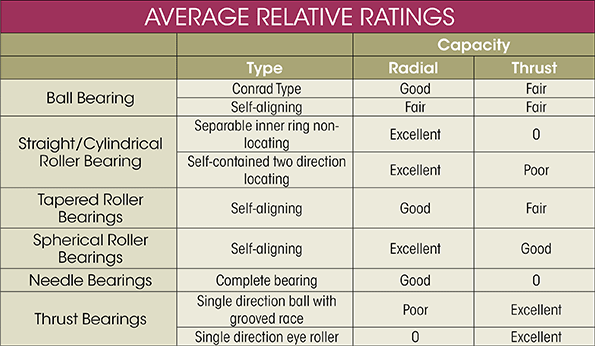
2. The table above lists some general types of ball bearings and their typical load capabilities.

Straight Roller Bearings

Straight roller or cylindrical bearings run in cylindrical raceways and have low-friction, high-radial load capacity, and high speed capability. Roller bearings are cylinder-shaped bearings where the point of contact between the bearing and the race is a line rather than a point. Load is distributed over a larger area and allows the bearing to handle a greater load. To minimize its tendency to skew, the roller’s length is not much greater than the diameter of the roller.


3. Straight or cylindrical roller bearings can be found in applications like conveyor-belt rollers, which are required to hold heavy radial loads.

Their usual design is free to float axially, and they have roller-guiding flanges on both sides of one ring and none on the other side. This allows for the bearing to expand due to thermal activity when used in combination with a ball bearing’s fixed location at the opposite end. A thrust load can be supported in one direction if a guiding flange is added on one of the opposing rings’ side. A second flange can be added for two-directional thrust capacity.

Tapered Roller Bearings


4. Tapered roller bearings are designed to withstand a radial and thrust load, and can be found in car hubs due to the amount of radial and thrust loads they can carry.

In a tapered roller bearing, the rings and the rollers are tapered in the shape of truncated cones to simultaneously support axial and radial loads. The ratio of the loads depends on the angle of the axes between the roller and bearing. The greater the angle is the greater axial load can be supported. The contact angle for most tapered roller bearings range is between 10 to 16 degrees. For higher thrust-load capacity, a 30-degree contact angle is used.


5. Tapered bearings are mounted pairs since they handle radial loads better than a single row of tapered bearings. For heavy-duty applications, two or four rows of tapered rollers are combined in a single unit in large bearings.

Spherical Roller Bearings

Spherical roller bearings typically consist of two rows of barrel-shaped rollers running in two raceways. One is on the inner ring and the other is on a continuous spherical surface ground on the inner diameter of the outer ring. This allows the bearing to operate with some misalignment. Spherical rollers have barrel profiles that closely match the raceways profiles, hence making them robust and having a high load capacity. They are mounted in pairs inside the bearing housing and are faced in opposite directions. This is done so that the load can be supported in either direction.


6. Spherical roller bearings are used in car hubs and can support large radial and thrust loads.

Needle Roller Bearings

Needle roller bearings use elongated cylindrical rolling elements with small diameters. They are used in applications where radial space is limited. The diameter to length ratio for the needles varies between 1-to-2.5 and 1-to-10. Due to their small size, they cannot be guided accurately and generate high amounts of friction. They are used at low speeds and oscillating motions as a result. Cages may be used to help guide the needles and improve retention.


7. Needle roller bearings are used in designs that have heavy space restrictions.

Thrust Bearings

Designed to handle high thrust loads, roller-thrust bearings are typically found in gearsets used for car transmissions between gears or between the housing and rotating shafts. The angled teeth found in helical gears used in car transmissions produce a high thrust load that is supported by the roller-thrust bearings. Roller-thrust bearings slide within a roller-race contact to handle the surface-speed variation that comes as a result of the varying diameter across the contact zone.


8. Ball-thrust bearings are designed to handle almost exclusively thrust loads in low-speed, low-weight applications. An example of its use would be in bar stools where they are used to support the seat.

Ball-thrust bearings are comprised of two grooved plates with a set of balls between them. The ball-race contacts have a sliding action that is increased at high speeds by the centrifugal force on the balls. Cylindrical roller thrust bearings are limited to about 20% of the speed of its radial bearing counterpart and ball-thrust bearings are limited to 30% of the speed of their counterpart.

How to Make Wooden Ball Bearings

Ball bearings—the familiar pieces that use balls to maintain the separation between the bearing races—have any number of uses. But the ones we're used to seeing in cars and other machines tend to be made of metal. Here, Matthais Wandel has a new video showing how to make them out of wood.


The first modern ball bearing design was developed in 1794, and they started going into bicycles in 1869. Everything from yo-yos to watches to jet engines use ball bearings in one way or another. New greaseless bearings spin with ten times less friction than previous models.

Friday, 4 November 2016

Bearing Market: Dynamics, Forecast, Analysis and Supply Demand 2015-2020

Bearing is an essential part of machinery which helps to reduce the friction of motion and increases the smoothness of machine. Bearings are widely use in automotive industry which helps to increase the speed of vehicle. Bearing reduces the friction between fixed and moving machine parts. However, it requires consistent maintenance to prevent early failure. The desperate need for energy-efficient vehicles and the expanding demand for bearings from the defense and aerospace industry increase the importance of bearing.

Bearing market is mainly driven by growing automotive market across the world. Strong growth of automotive sector in Asia Pacific region is expected to further drive the demand for bearing market through forecast period. The rising demand across various application sectors such as industrial, railways and aerospace sector is expected to witness a substantial growth during the forecast period. Development of seal technologies, light weight elements in high performance bearings and lubrication technologies gives some market growth opportunities.


The report covers forecast and analysis for the bearing market on a global and regional level. The study provides historic data of 2014 along with a forecast from 2014 to 2020 based on revenue (USD Billion). The report also offers detailed competitive landscape of the global bearing market. It includes company market share analysis, product portfolio of the major industry participants. The report provides detailed segmentation of the bearing market based on product, application segment and region. On the basis of product, the global bearing market is segmented into ball bearing, plain bearing and roller bearing. The ball bearing product segment of bearing market is the fastest growing segment of bearing market through the forecast period due to its advantages like smaller surface contact and less friction.

Automotive, agriculture, electrical, mining & construction, railway & aerospace and other applications are the key applications involved in the bearing market.  Bearing applications in motor vehicles that is automotive held the highest revenue share in 2014. Major regional segments analyzed in this study include North America, Europe, Asia Pacific, Latin America, and Middle East and Africa. This report also provides further bifurcation of region on the country level. Major countries analyzed in this reports are U.S., Germany, France, UK, China, Japan, India, and Brazil. Asia Pacific was the dominating region in the global market of bearing in 2014 due to booming automobile industry in this region. Asia Pacific is followed by Europe and North America.

This report segments the global bearing market as follows:

Global Bearing Market: Product Segment Analysis


  •     Ball bearing
  •     Plain bearing
  •     Roller bearing


Global Bearing Market: Application Segment Analysis

  •     Automotive
  •     Agriculture
  •     Electrical
  •     Mining & Construction
  •     Railway & Aerospace
  •     Others


Global Bearing Market: Regional Segment Analysis


  •     North America
  •         U.S.
  •     Europe
  •         UK
  •         France
  •         Germany
  •     Asia Pacific
  •         China
  •         Japan
  •         India
  •     Latin America
  •         Brazil
  •     Middle East & Africa


Wednesday, 26 October 2016

One-way roller clutches: one idea, many applications


  • Roller clutches transfer a torque in one direction and move freely in the opposite direction. In neutral, they have a low frictional torque, which prevents drive system losses and saves energy.
  •     Drawn cup roller clutches are used in a variety of industrial and automotive applications, including e-bikes, motorcycles, overrunning clutches and speed compensation devices


Bearing manufacturer company has seen an increase in demand for its one-way roller clutches, including applications on e-bikes (electric bikes) and motorcycles, as well as industrial applications in overrunning clutches for packaging machines and speed compensation devices for conveyor systems.

Roller clutches transfer a torque in one direction and move freely in the opposite direction. In neutral, they have a low frictional torque, which prevents drive system losses and saves energy.

Drawn cup roller clutches are high precision machine elements consisting of thin-walled, drawn outer rings (drawn cups) with a series of ramps on the inside diameter, plastic cages, springs and needle rollers. They can be used in a wide range of applications as backstops or overrunning clutches. Drawn cup roller clutches have extremely compact radial dimensions and carry out indexing from the locking direction in the freewheel direction. Roller clutches with bearing supports can also support radial forces.


Due to their low mass and the resulting low moment of inertia of the clamping elements, drawn cup roller clutches from Schaeffler are characterised by their high indexing frequencies. They also have a low overrunning frictional torque. As the needle rollers are individually spring retained, the shaft, needle roller and clamping surface remain in contact with each other at all times, which enables a high indexing accuracy to be achieved.

One-way clutches for e-bikes

Drawn cup roller clutches bearings are used as reliable one-way clutches for e-bikes, where they transmit high torques from the drive to the output components, for example, from the bottom bracket spindle to the chain ring. In central motor drives for e-bikes, drawn cup roller clutches perform an overrunning or locking function to decouple the central motor from the drive train. This is needed if the cyclist doesn’t require the assistance of the drive system, i.e. on a flat stretch of road or if the drive is deliberately switched off.

The HF, HFL and FRAX series of drawn cup roller clutches are particularly popular in bicycle applications. HF one-way clutches have an extremely compact design but have no bearing supports and so can only transmit torques. HFL series one-way clutches can also support radial forces due to the integral plain or rolling bearings. Both one-way clutch series are suitable for aluminium housings. Roller clutches with a knurled outside surface have the suffix ‘R’ and are suitable for use with plastic housings.

Protecting motorcycles

The FRAX series of roller clutches have a sleeve design with outer rings and integrated clamping ramps manufactured using forming methods, which improves manufacturing process reliability. Compared to drawn cup roller clutches with needle rollers, FRAX series roller clutches are capable of transferring much higher levels of torque. The compact design provides excellent power density, while simplifying assembly and mounting.

The most common application of the FRAX roller clutch is the E-starter one-way clutch for motorcycles. This forms the connection between the electric starter and the crankshaft. The one-way clutch safeguards the starter components from damage when the combustion engine is started and the engine speed exceeds that of the starter.

Roller clutches are also finding applications in automotive passenger cars, where they are used as one-way clutch discs for decoupling from irregularities in the powertrain drive, as well as automatic transmission converters, torque converters and hybrid transmissions.

Design calculation and simulation

In the automotive industry, minimising energy loss during the ‘engine idle’ phase has become increasingly important in reducing vehicle fuel consumption and CO2 emissions. The friction torque from the roller clutch can be minimised by optimal spring loading: if the outer ring rotates, the rollers can even lift off from the inner ring, eliminating roller clutch friction.

Monday, 24 October 2016

What is a Ball Bearing?

From small and large motors to car axles to electric fans and hard disc drives (HDDs), ball bearings are used in a wide array of machines for rotary motion. Ball bearings support rotary parts and reduce friction to facilitate the smooth operation of machines. The size of ball bearings can range from smaller than a grain of rice — small enough to fit inside a wristwatch—to over one meter in diameter for factory and power plant applications., 

Ball Bearing Components

Ball bearings are comprised of four major parts: a large ring (outer ring), a small ring (inner ring), balls between the rings (steel balls), and a cage to prevent the balls from hitting each other. The modern structure dates back to around 1500, when Leonardo da Vinci invented ball bearings to reduce friction against the axles of horsedrawn carts. For more than 500 years, the ball bearing has been defined by this simple structure.

The Precision of a Ball Bearing

The main function of a ball bearing is to reduce friction and facilitate smooth rotation of an axis. Modern ball bearings test the very limits of precision. As an example, one of the key elements to making an ultra-precise ball bearing is the degree to which the groove where the balls roll can be made into a perfect circle.
The most important performance measure in judging a ball bearing is the extent to which it reduces friction and facilitates smooth and easy rotation. Ball bearings may end up in aircraft, automobiles, precision medical equipment and many other end products, but no matter the application, it is important to maintain smoothness and minimize friction. Changes in the times brings diversification and complexity in end products and machine types along with new performance requirements for ball bearings, including miniaturization, higher rotation speeds, durability and duration, as well as noise reduction.
 
 The world’s largest manufacturer of miniature precision ball bearingsand a volume leader in the design and manufacturing of precision electro-mechanical components, including cooling fans and blowersprecision small motors and mechanical bearing assemblies, as well as a total solutions supplier of backlight, and LED programmable drivers. products can be found in the personal computing, networking, telecommunications, home entertainment, home electronics, and automotive, medical and industrial markets.

Wednesday, 19 October 2016

Bearings has much to gain from new auto emission rules

Implementation of stricter emission rules may pinch those who want to buy new vehicles, but for bearings companies, it is turning into an incremental revenue driver.

India’s largest supplier of bearings to the passenger car segment, is well poised to benefit from increased demand for next-generation bearings which contribute to lower emissions by improving vehicle performance.

promoted by Germany’s Schaeffler Group, may outpace the industry as well as its own historical performance in revenue growth in the next few years. Between 2010 and 2015, its annual growth was 10% with revenue expanding to Rs 1,707 crore, as per company’s annual report.

With the deadlines on the emission rules — April 2017 for BS-IV and April 2020 for BS-VI — drawing closer, automakers are expected to shift to next generation bearings, opening up a revenue opportunity for the component makers. All Bearings Company is expected to reap the highest benefit since it is the market leader in the passenger car segment where volume visibility is the highest among all the automobile segments — its market share in the passenger car segment is expected to increase to 18.9% in 2020 from 16.7% in the last fiscal, according to Kotak Institutional Equities. All Bearings companies’ overall revenue market share was nearly 15% in the last fiscal year.

Its financial year ends in December. Since the new generation of bearings are almost 2.5-3 times expensive than the conventional ones, the changes will help the company better its average realisation as well as margins.


According to analysts, the bearings content will increase to Rs 4,000 per car in 2020 from Rs 3,000 currently, another factor that bodes well for the segment. the Bearings enjoys superior market position compared to its peers due to lower sourcing of goods from the parent to sell in the local market and better margins on traded goods.

Bearings has commissioned a new plant at Savli in Gujarat with an investment of Rs 400 crore and it has potential to generate Rs 1,000 crore in revenue at peak utilisation. With higher utilisation of the new plant and increased proportion of the newgeneration bearings in its product mix could help the company boost its margins. Last year, its operating margin was 17.7%.

Also, the company would benefit from an expected increase in the use of technologically better bearings in trucks and the railways. The government’s plan to upgrade railway infrastructure by projects such as dedicated freight corridors, high-speed trains and metros in major cities can nearly double the demand for bearings from the railways. This may bode well for companies in the sector.

At Friday’s closing price of Rs 4,182.85 on the BSE, the stock is trading at 23 times its FY18 projected earnings. This is at par with tier one automakers and appears justified due to the company’s superior earnings growth and market position to capture the changing trends in the industry.

Roller Bearing for Large Gear Boxes

Combination of special heat treatment and material for superior life expectancy

Designed to improve the reliability of large gearboxes used in wind power generators and other industrial machines, NSK has introduced a long-life, large-size roller bearing. The principal innovation of the new bearing is a combination of special heat treatment technology and proprietary NSK material that delivers superior flaking resistance, including that of white structure flaking. The result is seven times longer service life than that provided by a standard steel (SUJ2) bearing.

The gearboxes found in wind power generators and mining, steelmaking and construction equipment, require roller bearings that are able to support heavy loads. In addition, such bearings must demonstrate excellent reliability in order to cope with the increasing size of wind power generators being produced, and the harsh operating conditions of industrial machinery.


It was these factors that prompted NSK to create a robust, large bearing capable of class-leading reliability. This task demanded the development of a special heat treatment process that was able to delay the occurrence and propagation of cracks.

As a result of these innovations, NSK’s roller bearings for large gearboxes demonstrates seven times longer white structure flaking life than a conventional standard steel bearing. Furthermore, surface originated flaking life is three times as long, while substrate originated flaking life and fracture toughness are both double. As an additional benefit, the rate of dimensional change offered by NSK’s roller bearing for large gearboxes is 50 times less than that of conventional alternatives.

In conclusion, today’s large gearbox designers should consider the use of NSK’s long-life large roller bearing for improved reliability in harsh environments. NSK is anticipating global annual sales for this product of around €8 million by 2017.